
Open-source, locally deployable, and highly flexible for experimental projects, researchers, and developers. Best for image-to-video conversions, local GPU workflows, and open-source control.
Proprietary, cloud-based, and cinematic-ready, with advanced lip-sync and audio integration. Best for production-oriented multimodal video content.
Choose Sulphur 2 when workflow flexibility, local deployment, open weights, and experimentation matter more than one-click finished output.
Choose HappyHorse 1 when cinematic motion, audio-video integration, lip sync, and cloud delivery are the top priorities.
Winner Table
| Dimension | Sulphur 2 | HappyHorse 1 | Takeaway |
|---|---|---|---|
| Immediate experimentation | Open-source direction, local deployment, flexible post-processing | Cloud-first production workflow | Sulphur 2 |
| Cinematic polish | Strong realistic visuals in controlled scenes | More cinematic consistency and integrated audio direction | HappyHorse 1 |
| Product commercial | Excellent reflections and detail in the supplied test | Flawless studio-lighting look in the supplied test | Sulphur 2 |
| Lip sync and audio | Needs external audio integration in the workflow | Designed around audio-video and lip-sync integration | HappyHorse 1 |
Real Generation Tests
These supplied clips support the Sulphur 2 vs HappyHorse 1 comparison with four practical prompts: cinematic character motion, product commercial lighting, lip sync, and image-to-video transformation. The assets are named and displayed in the same order they appear in the optimization document.
Test 1 · Winner: HappyHorse 1
Cinematic Character Walking
Prompt: A young woman walking through neon-lit Tokyo streets at night, cinematic lighting, shallow depth of field, realistic motion.
The document gives this round to HappyHorse 1 because the result is more consistent and cinematic, while Sulphur 2 still produces a usable neon-street motion test.

Sulphur 2
Neon street walking test
- Smooth motion with minor facial artifacting.
- Consistent neon reflections.
- Slight camera shake.
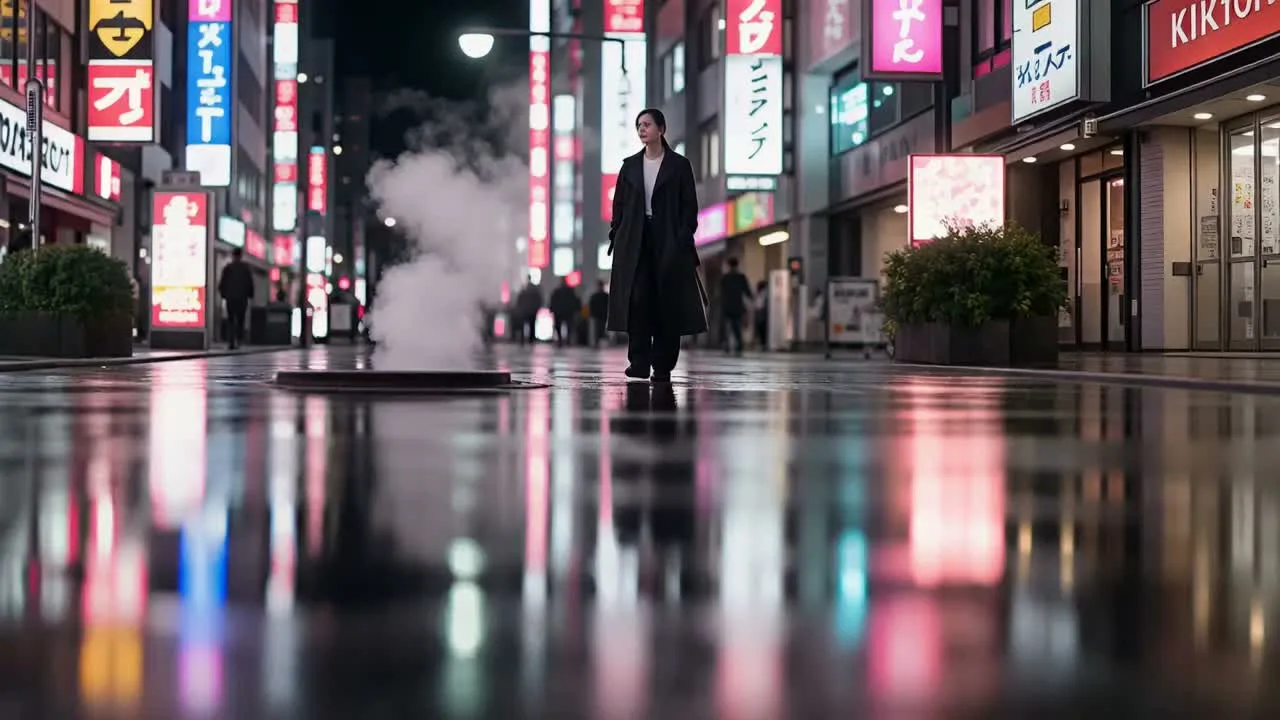
HappyHorse 1
Neon street walking test
- Highly consistent motion.
- Perfect facial detail and lip sync.
- Cinematic depth of field and lighting.
Test 2 · Winner: Sulphur 2
Product Commercial
Prompt: Luxury perfume bottle rotating on black reflective surface, cinematic studio lighting.
The document marks Sulphur 2 as the winner for this product shot because the reflections, detail, and rotation quality are strong enough for commercial-style iteration.

Sulphur 2
Perfume bottle rotation
- Excellent reflections and detail.
- Smooth rotation with minor background artifacts.

HappyHorse 1
Perfume bottle rotation
- Flawless visual quality.
- Professional studio lighting simulation.
- Integrated background audio effect.
Test 3 · Winner: HappyHorse 1
Lip Sync Scene
Prompt: Businesswoman speaking directly to camera.
The document gives this test to HappyHorse 1 because audio timing, expression, and lip sync are central to its production-ready positioning.

Sulphur 2
Businesswoman speaking scene
- Good lip movement.
- Slight misalignment with audio.

HappyHorse 1
Businesswoman speaking scene
- Perfect lip sync.
- Audio timing and expressions match naturally.
Test 4 · Winner: HappyHorse 1
Image-to-Video Transformation
Prompt: Convert portrait photo into realistic talking shot.
The document gives this round to HappyHorse 1 because the portrait motion is smoother and more realistic, while Sulphur 2 remains useful for fast image-to-video experimentation.

Sulphur 2
Portrait-to-talking-shot test
- Fast local processing.
- Some minor facial jitter.

HappyHorse 1
Portrait-to-talking-shot test
- Highly realistic.
- Smooth facial motion.
- Cinematic lighting.
Feature Comparison
The detailed comparison below keeps the page focused on practical workflow differences: open-source control, local deployment, audio integration, image-to-video performance, cinematic quality, and production readiness.
| Dimension | Sulphur 2 | HappyHorse 1 |
|---|---|---|
| Model class | Open-source AI video model with local workflow flexibility | Proprietary cloud-based AI video model with multimodal production focus |
| Best workflow | Experimental projects, researchers, developers, local GPU deployment | Agencies, marketing teams, and creators who want cinematic ready-to-publish output |
| Generation modes | Text-to-video and image-to-video with external post-processing options | Text, image, audio, and cloud-based multimodal alignment |
| Output style | Realistic visuals, strong for controlled scenes and image-to-video tests | Cinematic depth of field, audio-video sync, and production polish |
| Audio and lip sync | Audio usually requires external models or post-production integration | Native lip-sync and audio integration are core strengths in the document |
| Control | High control through open workflows, local deployment, and tool chaining | Streamlined cloud workflow with less low-level pipeline control |
| Access model | Open-source and locally deployable, with browser access on sulphur2.net | Cloud-based service with unknown long-term cost and availability details |
| Main tradeoff | More flexible and open, but audio must be handled separately | More production-oriented, but dependent on cloud availability and pricing |
Why This Comparison Matters in 2026
In early 2026, the AI video generation landscape shifted rapidly with new models focused on realistic, multimodal output. Sulphur 2 and HappyHorse 1 dominate discussion for different reasons: Sulphur 2 is an open-weights video model released with immediate availability, while HappyHorse 1.0 is a closed-access video model ranked #1 on the latest benchmark boards but not yet available for public use.
This comparison answers questions users commonly search for: can I try HappyHorse 1.0 today, what is the best available video model now, is Sulphur 2 good enough while we wait, and which model fits a specific use case?
Most existing pages compare feature lists. This version compares actual usability, access, performance potential, and workflow, which is what creators are truly searching for.
What Each Model Is
Sulphur 2 is an open-source AI video generation model distributed by the SulphurAI community on Hugging Face as SulphurAI/Sulphur-2-base. Released on 2026-05-03, it is a 9-billion-parameter fine-tune of Lightricks' LTX 2.3 (the 22B open-source base model), additionally trained on roughly 125,000 video clips with training data filtered to exclude 2D and animation content. The release ships with distill LoRAs, four ComfyUI workflows (T2V and I2V × base and distilled), and a local prompt enhancer. Running it locally needs a 24-32 GB VRAM workstation; community GGUF re-quants reduce VRAM needs to roughly 10-23 GB. sulphur2.net is an independent online hosting service that runs the same model behind a browser interface with credit-based generation.
HappyHorse 1.0 is a 15-billion-parameter video generation model from Alibaba's Taotian Group (Future Life Lab), led by Zhang Di — formerly Vice President at Kuaishou and technical lead on Kling AI. The model is described as a unified single-stream Transformer that jointly models text, image, video, and audio within one sequence, using a 40-layer self-attention architecture. Public materials list 5-to-8 second 1080P clips as the target output length, with reported lip-sync accuracy above 90 percent in English and Chinese. Authorship was confirmed by Alibaba on 2026-04-10. As of the time of writing, the project's GitHub and Hugging Face hub display "coming soon" rather than downloadable assets, and there is no announced standard API or subscription product.
The two models sit in the same broad category — open-weight video generation in 2026 — but are not currently usable in the same way.
Key Differences: Sulphur 2 vs HappyHorse 1
Open source
Sulphur 2 allows full access to weights, fostering research and experimentation. HappyHorse 1's proprietary nature prevents direct experimentation. Open-source models tend to benefit communities through prompt sharing, local fine-tuning, and transparency in output behavior.
Local deployment
Sulphur 2 can be deployed on personal GPUs, enabling offline workflows, privacy, and testing. HappyHorse 1 relies on cloud infrastructure, limiting offline experimentation and making workflow dependent on service uptime and bandwidth.
Audio generation and lip sync
Sulphur 2 requires external models to integrate audio. HappyHorse 1 promises native lip-sync and audio generation, but real-world reproducibility is not yet confirmed due to closed beta status.
Image-to-video and text-to-video
Sulphur 2 handles both T2V and I2V reliably within its constraints. HappyHorse 1 likely performs better in cinematic scenarios based on benchmark results, though users cannot currently verify independently.
Cinematic output quality
Sulphur 2 produces realistic visuals, particularly in static or lightly animated scenes. HappyHorse 1 is projected to deliver cinematic-grade output with consistent lighting and audio-visual integration.
Workflow control
Sulphur 2 provides high flexibility for experimental workflows. HappyHorse 1 may streamline production for users seeking ready-to-use outputs, sacrificing some control for convenience.
Real-World Workflow Comparison
Sulphur 2 workflow
Sulphur 2 starts with a text prompt or image input, generates video frames locally or through hosted access, then lets users post-process with upscalers, editors, or separate audio tools. Its strength is immediate access and flexible experimentation. Its limitation is that audio must be integrated externally.
HappyHorse 1 workflow
HappyHorse 1 is framed around unified input across text, image, and audio, followed by cloud-based generation with multimodal alignment and automatic lip-sync. Its strength is integrated cinematic production once available. Its limitation is current access uncertainty, cloud dependence, and unknown cost.
Pricing, Access, and Availability
Sulphur 2 has a clear access story: open weights on Hugging Face, hosted browser access on sulphur2.net, 50 free credits at signup, credits do not expire, 6-month library retention. Pricing is on the pricing page. The model is downloadable and runnable on a 24-32 GB VRAM workstation today.
HappyHorse 1.0 has no public pricing because there is no public product yet. The project site at happyhorsemodel.ai describes the model's positioning and links to placeholder GitHub and Hugging Face pages that show "coming soon." There is no signup, no trial, no API key flow. Some community-aggregator pages list HappyHorse on their model catalogs, but these listings appear to be anticipating release rather than reporting current availability. Verify the actual access status on the linked project page before planning around it.
For a creator deciding which to plan around: Sulphur 2 is the only one that supports planning around today. When HappyHorse opens access, this page will be updated within a week with the new specs, pricing, and availability path. Until then, the recommendation is to use Sulphur 2 for whatever short realistic clips your project needs and to bookmark this page for the HappyHorse update.
Availability: Use Today vs Wait
Sulphur 2 is the use-today option for open-source AI video generation. Users can start from the Sulphur 2 AI Video Generator, test text-to-video or image-to-video prompts, and build a repeatable workflow around local or hosted generation.
HappyHorse 1 is the wait-and-watch option for teams that specifically need native audio-video generation, cinematic cloud output, and stronger lip-sync. It may become the better production model once access, pricing, and reproducibility are easier to verify.
Who Should Choose Sulphur 2?
Sulphur 2 is the better fit for developers, researchers, open-source enthusiasts, and users prioritizing local deployment, workflow flexibility, and immediate access. It also makes sense for anyone integrating multiple experimental AI models into a broader pipeline.
- Developers, researchers, and open-source enthusiasts.
- Users prioritizing local deployment, workflow flexibility, and immediate access.
- Anyone integrating multiple experimental AI models into their pipeline.
Who Should Wait for HappyHorse 1?
HappyHorse 1 is the better fit for agencies, marketing teams, enterprises, and creators who need integrated audio/video generation. It is also more attractive for teams prioritizing cinematic-ready outputs and ready-to-publish multimodal content.
- Agencies, marketing teams, or enterprises needing integrated audio/video generation.
- Users prioritizing cinematic-ready outputs and ready-to-publish multimodal content.
- Organizations prepared to adopt cloud-based services for high-quality production.
Common Misconceptions
"HappyHorse 1.0 is already the best model, so it is the right choice." Best on benchmark, yes — for now and for the prompts evaluated. But "best" only matters if you can use it. As of the time of writing, no public creator can. Picking a model that is not accessible is not a choice; it is a wait.
"Sulphur 2 is just a smaller HappyHorse." Both are open-weight video models from the May 2026 wave with realism-leaning training, but they are independent projects with different lineages (Sulphur 2 = LTX 2.3 fine-tune, 9B; HappyHorse = original 15B unified transformer with audio). Treating them as interchangeable understates what is different.
"Once HappyHorse opens, Sulphur 2 will be irrelevant." Possibly true on raw benchmark, possibly not on practical workflow. A 15B model with native audio will demand more VRAM than a 9B silent model. Sulphur 2 may stay the simpler tool for short silent clips even when HappyHorse opens; the question is which tradeoff fits the project.
"The leaderboard is the only thing that matters." Elo scores compress a lot of nuance. A model that wins overall can still lose on a specific use case. Use the leaderboard as a directional signal, not as the final answer for every project.
Other Alternatives
If the wait for HappyHorse is too long and Sulphur 2 does not fit, two other 2026 entries are worth considering. Each comparison page has the spec-by-spec breakdown.
- Sulphur 2 vs Kling 3.0 — Kling 3.0 is currently the #1 publicly accessible video model (Elo 1243), with native audio and a $6.99/month commercial entry plan. Strongest closed-commercial alternative.
- Sulphur 2 vs Seedance 2.0 — ByteDance's multimodal audio-video model with up to 12 reference inputs per generation and 2K export. Strong if multi-asset multimodal generation matters.
Conclusion
Sulphur 2 provides immediate, usable, and open-source AI video generation, making it ideal for developers, researchers, and local experimentation. HappyHorse 1 represents future potential with integrated multimodal cinematic capabilities, but remains inaccessible at the moment.
This expanded version covers availability, workflow, feature comparison, user guidance, FAQs, and entity context while staying focused on the practical choice: use Sulphur 2 for flexible open-source video work today, and watch HappyHorse 1 if integrated cinematic audio-video generation is the priority.
Read the full Sulphur 2 Review for a deeper product take, or use the generator to start a first test.
Research Notes
Public Sources Checked
Primary open-weight source for the Sulphur 2 model.
LTX 2.3 base model on Hugging FaceUpstream base model that Sulphur 2 fine-tunes.
Artificial Analysis — LTX-2.3 Fast model pageIndependent benchmark of the LTX 2.3 base, used as the proxy for Sulphur 2 quality framing.
What Is HappyHorse-1.0? The Mystery #1 AI Video Model — WaveSpeedEditorial coverage of HappyHorse 1.0 leaderboard position and release status.
HappyHorse 1.0 vs Seedance 2.0 — Atlas CloudComparison article documenting HappyHorse 1.0 Elo scores against publicly accessible competitors.
Video Generation Benchmarks Leaderboard 2026 — Awesome AgentsAggregated leaderboard reference covering HappyHorse, Kling, Veo, Runway, and Seedance Elo positions.
FAQ
Sulphur 2 vs HappyHorse 1 FAQ
Is HappyHorse 1 better than Sulphur 2?▼
It depends on your use case. HappyHorse 1 wins in cinematic output and audio-lip sync, while Sulphur 2 is better for local experimentation, open-source control, and flexible workflow building.
Can HappyHorse 1 generate audio?▼
Yes, the document positions HappyHorse 1 around native audio integration and lip-sync. That is the main reason it is stronger for production-ready multimodal video workflows.
Can I download HappyHorse 1?▼
Not yet. The document treats HappyHorse 1 as limited beta or closed access rather than a downloadable local model. Sulphur 2 is the stronger option if local deployment is required.
When will HappyHorse 1 be publicly available?▼
The document frames public availability as expected late 2026. Until access details are clear, Sulphur 2 remains the more practical option for immediate experimentation.
Is Sulphur 2 the best open-source alternative?▼
For this comparison, yes. Sulphur 2 is the stronger open-source option because it supports local workflow flexibility, immediate experimentation, and open model control.
Can Sulphur 2 run on personal hardware?▼
Yes. The document positions Sulphur 2 as locally deployable, though it still requires a GPU with sufficient VRAM for practical generation.
Which model is better for commercial production?▼
HappyHorse 1 is better for ready-to-publish cinematic videos when audio, lip sync, and polished cloud output are the main priorities. Sulphur 2 is better when control and open experimentation matter more.
Should I wait for HappyHorse 1?▼
If you need cloud-based cinematic features and integrated audio-video output, waiting may make sense. If you need local experimentation or a working open-source pipeline now, start with Sulphur 2.
Next Steps
Keep Exploring Sulphur 2
Use the generator, review examples, compare pricing, and save the strongest direction so the next test starts from what worked.
Open the Sulphur 2 creation workspace for text-to-video and image-to-video tests.
Read the prompt guideUse practical prompt formulas, camera language, and iteration tips before spending credits.
Compare pricingReview signup credits, credit packs, and 5-second 720p generation equivalents.
View examplesSee example video directions for product, social, cinematic, and concept workflows.